Best Used Cars for Sale: The Complete Guide to Finding Great Deals at Trusted Dealerships
Buying used is one of the smarter financial moves you can make on a vehicle — but the margin between a good deal and an expensive mistake is thinner than most buyers realize. After years of helping customers navigate the pre-owned market, we've seen what works, what goes wrong, and what actually matters when you're spending serious money on someone else's previous ride.
Table of Contents
- 1. Why Buy Used? The Real Numbers Behind the Decision
- 2. Best Used Cars Under $5,000
- 3. Best Value Picks Under $10,000
- 4. Choosing the Right Vehicle Type
- 5. Dealership vs. Private Seller: What Nobody Tells You
- 6. The Costs Buyers Forget to Budget For
- 7. How to Inspect a Used Car Before You Commit
- 8. Frequently Asked Questions

Getting the keys to your next ride — make it count
Why Buy Used? The Real Numbers Behind the Decision
A new car that stickers at $32,000 is typically worth somewhere around $22,000 by year three and closer to $17,000 by year five. Buy that same car at the three-year mark and you've skipped $10,000 in depreciation the first owner paid. Insurance premiums are lower on older vehicles, loan amounts are smaller, and registration fees in most states scale down with vehicle age.
None of that matters if you pick the wrong car. A $4,000 vehicle with 130,000 miles can look like a deal right up until the transmission goes. We've lost count of how many times we've seen someone buy a low-price private sale, skip the pre-purchase inspection to save $120, and end up back at a shop two months later with a repair estimate that eclipses what they saved. The inspection wasn't necessarily going to stop them from buying — but it would have given them a real number to negotiate from, or a reason to walk. For most buyers, the 40,000 to 90,000 mile range is where you typically find the best balance — most depreciation has already happened, but major mechanical wear usually hasn't started in earnest.
| Purchase Age | Depreciation Absorbed by Previous Owner | Your Upside |
|---|---|---|
| 1–2 years old | 15–25% | Near-new condition, often still under manufacturer warranty |
| 3–5 years old | 35–50% | Best balance of price, condition, and remaining life |
| 6–10 years old | 55–70% | Budget-friendly; reliability brand matters more here |
| 10+ years old | 70–85%+ | Lowest entry cost; higher maintenance risk |
Best Used Cars Under $5,000: Reliable Options on a Tight Budget
Under $5,000, brand matters more than it does at any other price point. You're mostly looking at 2008–2013 cars with somewhere between 90,000 and 130,000 miles on them. A 2009 Toyota Corolla with 110,000 miles is a more sensible buy than a 2011 American sedan at 80,000 — the Corolla is statistically more likely to hit 200,000 with nothing more than oil changes and occasional brake jobs. At this price, reliability history isn't a nice-to-have. It's the whole decision.
Top Picks Under $5,000
| Model | Typical Years | Why It Makes the List | Average Price Range |
|---|---|---|---|
| Toyota Corolla | 2008–2012 | Bulletproof 1.8L engine, parts are cheap and everywhere | $3,500 – $5,000 |
| Honda Civic | 2007–2011 | Responsive handling, holds up well at high miles | $3,500 – $5,000 |
| Ford Focus | 2008–2012 | Comfortable for the price; skip the dual-clutch automatic from 2012–2016 | $2,500 – $4,500 |
| Nissan Altima | 2007–2010 | Large interior, solid highway cruiser; watch CVT on higher-mileage units | $3,000 – $4,800 |
| Hyundai Elantra | 2007–2010 | Underrated reliability record; original warranty sometimes still partially transferable | $2,800 – $4,500 |
One thing to watch at this price range: a $3,200 car that needs $1,800 in brakes, tires, and fluids isn't cheaper than a $4,800 car that's been maintained. Ask for service records upfront. A seller who can produce them (even partial ones) is giving you real information. A seller who doesn't have them isn't necessarily hiding anything, but you're taking on more unknowns.
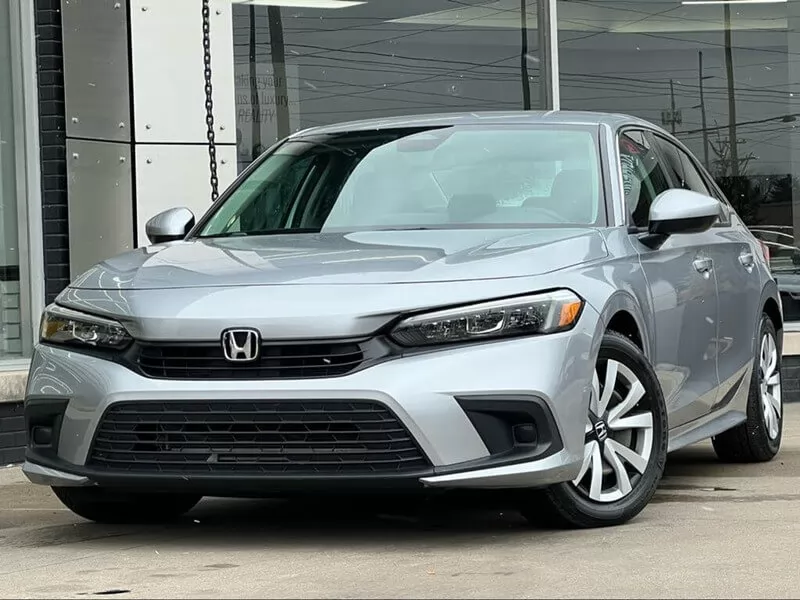
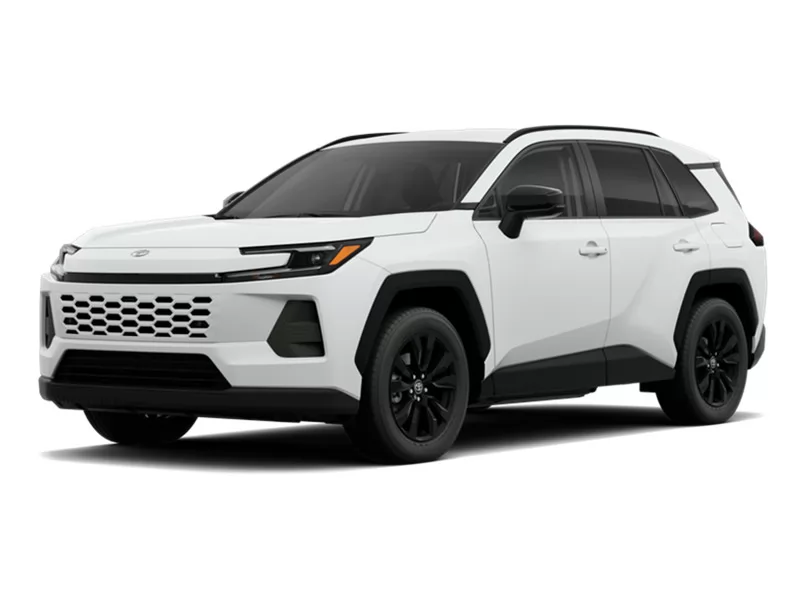
Honda Civic (left) for budget buyers, Toyota RAV4 (right) for those needing more space
Best Value Picks Under $10,000
The $7,000–$10,000 range gets you into 2014–2017 model years with real features — backup cameras, lane assist, in some cases Apple CarPlay — on cars that have already absorbed most of their depreciation. This is the range we'd point most buyers toward first. You're not making a compromise; you're letting someone else absorb the first-year hit on a car that still has years of useful life ahead.
Best Picks by Category
$6,000 – $10,000
Sedans
- Toyota Camry (2012–2015)
- Honda Accord (2012–2015)
- Hyundai Sonata (2014–2016)
- Nissan Altima (2013–2016)
$7,000 – $10,000
SUVs
- Honda CR-V (2012–2015)
- Toyota RAV4 (2013–2015)
- Ford Escape (2013–2015)
- Chevrolet Equinox (2013–2015)
$5,000 – $9,000
Hatchbacks
- Volkswagen Golf (2012–2014)
- Ford Fiesta (2014–2016)
- Hyundai Veloster (2012–2015)
One underappreciated move at this price point: look at cars coming off fleet or rental service. Rental companies maintain on schedule because a breakdown is a liability issue, not just an inconvenience. A 2015 Honda Accord with 75,000 documented fleet miles is often a smarter buy than a private-party car at 55,000 miles with a spotty paper trail. Before you negotiate anything, pull the car's market value from Kelley Blue Book. Dealers price above market expecting a counteroffer, and pointing to KBB fair market value with a specific number usually moves the price without any confrontation.
Choosing the Right Vehicle Type
Before you start filtering listings, ask yourself honestly: when did you last actually need the full capacity of the vehicle you're picturing? Most buyers have a real use case in mind — camping a few times a year, helping someone move, a road trip with luggage. Those scenarios matter. They just don't always require the vehicle you're imagining. The question isn't whether a full-size SUV would be useful sometimes. It's whether that usefulness justifies what you'll spend on fuel and parking every week for the next three years.
Used SUVs
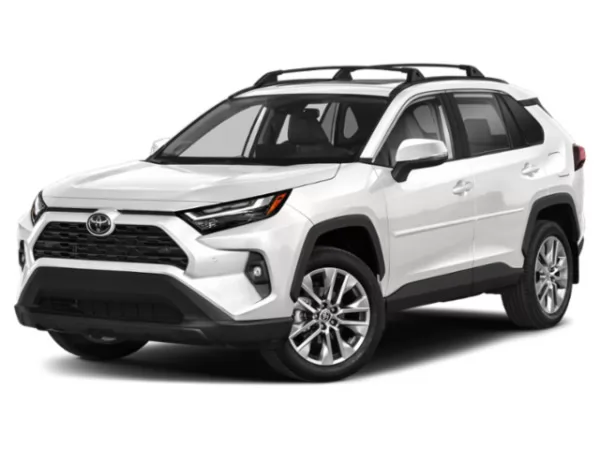
Compact SUVs like the Toyota RAV4 offer versatility without the bulk
Full-size SUVs like the Toyota Highlander, Ford Explorer, and Chevrolet Traverse make sense if you're regularly hauling a full family plus gear, or towing. For most buyers, that scenario does come up — just not every week. If your typical trip is a school run and grocery store, a compact CR-V or RAV4 handles it just as well, parks more easily, and uses noticeably less fuel. Go bigger when the use case actually calls for it.
Used Electric Vehicles (EVs)
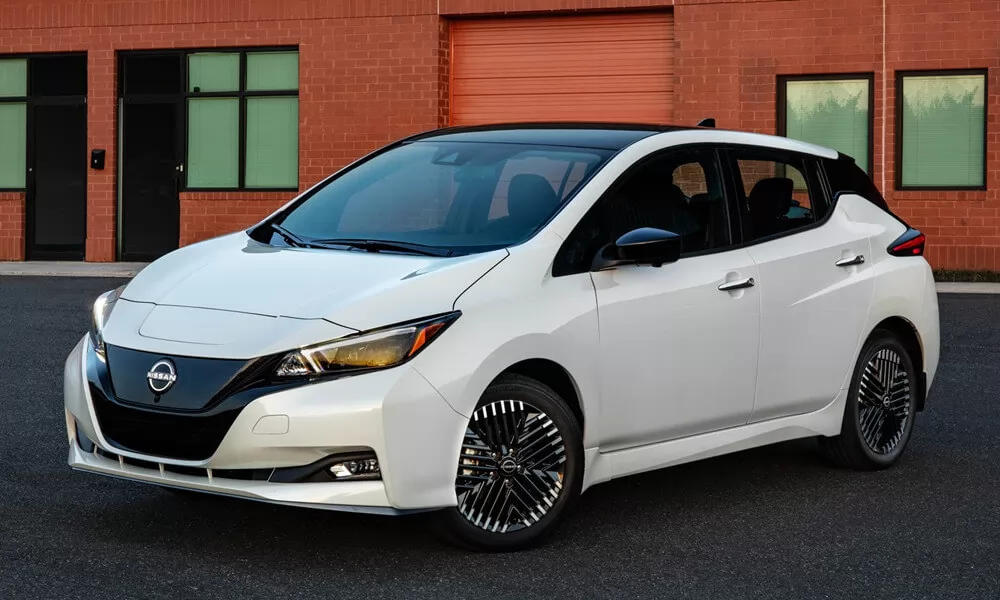
Used EVs like the Nissan Leaf offer affordable electric driving
Used EVs are a more reasonable proposition than they were two or three years ago. Prices on first-gen Nissan Leafs, Chevrolet Bolts, and older Tesla Model S units have dropped to where the math actually works, especially if you charge at home overnight. Before anything else, ask for a battery state-of-health (SoH) report. A Leaf with 80,000 miles and 85% battery health is worth considerably more than one at 50,000 miles sitting at 72%. Mileage is almost irrelevant compared to that number. If the seller won't provide one, budget the cost of a third-party test into your offer.
One thing worth confirming before you make an offer: Nissan covers the Leaf's battery for 8 years or 100,000 miles against capacity dropping below 75%, and that warranty transfers to subsequent owners. On a higher-mileage unit where the SoH sits in the 78–82% range, that coverage changes the math considerably — it's the difference between a calculated risk and a reasonable purchase.
Used Hybrids
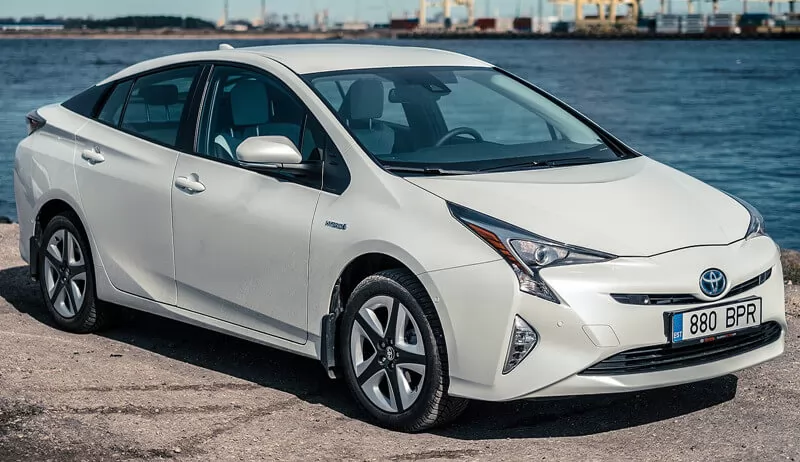
Toyota Prius - the gold standard for fuel-efficient hybrids
The Toyota Prius has earned its reputation with cab fleets in New York and San Francisco. Commercial operators running cars 80,000-plus miles a year aren't sentimental about vehicle choice; they run Priuses because the hybrid battery holds up and the fuel savings are real at that scale. The Camry Hybrid and Honda Accord Hybrid offer similar efficiency in a more conventional body if you don't want the Prius shape. As for battery replacement costs: industry estimates in recent years have generally put Prius battery replacement in the $2,000–$2,800 range including labor, down significantly from where it was a decade ago as refurbished pack options have expanded. High-mileage hybrid buys carry less financial risk than they used to.
Used Luxury Cars
European luxury cars depreciate hard, and for a prepared buyer that creates an opening. A 2018 BMW 3 Series or Mercedes C-Class that stickered at $45,000 can be had for roughly half that at four years old. The catch is that running costs don't depreciate with the purchase price — parts are expensive, oil changes cost twice what they do on a Civic, and a single out-of-warranty repair can easily run several thousand dollars.
A pre-purchase inspection on a European luxury car is less an optional step and more the whole decision — not because every used BMW is a problem, but because the inspection report is what lets you negotiate intelligently. When a mechanic comes back with a list of deferred work, that list either becomes your price reduction or your reason to leave. Both outcomes are better than discovering it three months later on your own dime. If a seller won't allow an independent inspection on a $22,000 vehicle, walk away. That kind of resistance is its own answer.
Before buying any used luxury vehicle, get a pre-purchase inspection from a shop that specifically services that brand. A general mechanic will miss things. Budget honestly for maintenance and this category makes sense. Skip that step and the savings on the sticker price will disappear quickly.
Used Minivans

Minivans offer the most practical interior space for families
The Toyota Sienna and Honda Odyssey sit at the top of owner satisfaction surveys for family vehicles, and the reasons are practical: sliding doors, a flat floor in the back, and second-row legroom that most SUVs can't match. If you're moving three or more kids regularly, or helping older family members in and out of a vehicle, sliding doors alone justify the category. The Chrysler Pacifica is worth considering here too — it's come a long way from the old Dodge Grand Caravan and tends to be priced lower than the Japanese options at comparable mileage.
Worth Mentioning: A Few Overlooked Options
Convertibles get dismissed quickly because most buyers assume the insurance is brutal or the practicality isn't there. Both are partly true. But if you're specifically buying a second car for warmer months, a used Mazda MX-5 or a base-trim Mustang convertible from the right climate — Arizona, Southern California, Texas — is one of the better-value buys in the used market. Rust is the issue with northern convertibles; a clean southern example is a different proposition entirely.
Station wagons — specifically the Subaru Outback and Volvo V60 — consistently get underpriced because Americans don't buy them in volume. You get near-SUV cargo capacity, better handling, and usually a lower asking price than a comparable crossover with similar specs. If you've written off the category, it's worth a second look.
Sports cars at 4–6 years old are where depreciation math works most dramatically in a buyer's favor. A used Subaru WRX or Mustang GT that stickered at $35,000 can often be found for $18,000–$21,000 with reasonable miles. Insurance will cost more — get a quote before you get attached to a specific car.
Dealership vs. Private Seller: What Nobody Tells You
Both channels have real advantages. The right choice mostly depends on how much legwork you want to do and how much uncertainty you can absorb.
Buying from a Dealership
Franchise dealerships and reputable independent lots give you things you can't get privately: documented inspections, financing options, trade-in credit, and lemon law protections in most states. You're paying for that infrastructure, and some of it you can negotiate. Documentation fees are frequently adjustable. A polite but direct "I'd like that reduced" works more often than buyers expect.
Certified Pre-Owned programs deserve a closer look on European or near-luxury vehicles. Manufacturer-backed CPO cars go through a thorough inspection and come with extended warranties, often covering 5 years or 100,000 miles from the original sale date. On a mainstream Toyota or Honda, the CPO premium is hard to justify since the reliability is already there. On a German brand where an out-of-warranty repair can run several thousand dollars, that coverage is paying for something real. Read the terms carefully either way; coverage varies a lot between manufacturers, and some programs exclude common wear items.
Buying from a Private Seller
Private sales typically run 10-15% below dealer prices, and there's more room to negotiate because the seller isn't answering to a floor manager. The downside is you're on your own: no warranty, no financing, and you handle the title transfer yourself. Before handing over money, run a CARFAX or AutoCheck report, get a pre-purchase inspection from a mechanic you found independently (not one the seller recommends), and verify there are no open liens on the title through your state's DMV. It's a bit more work, but for the right car at the right price, it's worth it.
Dealership Advantages
- Warranty and CPO options
- In-house financing
- Trade-in accepted
- Consumer law protections
- Documented vehicle history
Private Seller Advantages
- Typically lower asking price
- More room to negotiate
- Direct access to ownership history
- No documentation or dealer fees

A reputable dealership offers warranty protection and financing options
Online Marketplaces
The major platforms let you filter by price, mileage, distance, and vehicle type — useful for benchmarking before you visit any lot. Use them to understand what's available locally, then verify any listing independently before meeting a seller. Scams targeting used car buyers have become more common in recent years; never wire money or send a deposit without seeing the car in person. Any seller who needs payment before a viewing is not a seller you should do business with.
Second Chance Auto Sales
Dealers specializing in buyers with challenged credit can be a legitimate path, but the math needs scrutiny. Approval comes at a cost: interest rates at these lots commonly run 18-25% APR, which adds thousands to the total cost of a $10,000 car over a 48-month loan. If this is your route, calculate the full payoff amount, not the monthly payment, before you sign anything.
The Costs Buyers Forget to Budget For
The sticker price is only part of what you'll actually spend in the first few months. These are the costs that consistently catch buyers off guard.
| Cost | Typical Range | Notes |
|---|---|---|
| Sales Tax | 4–8% of purchase price | State-dependent; California base rate is 7.25%, some counties add more |
| Registration & Title | $50 – $300 | One-time; varies by state and vehicle value |
| Documentation Fee | $50 – $500 | Dealer processing charge; push back on anything over $200 |
| Immediate Repairs | $300 – $2,000 | Brakes, tires, fluids — assume something needs attention regardless of how clean the car looks |
| Insurance | $100 – $200/month | Get a quote before you buy, not after |
Budget extra: Add 15-20% on top of the car's price. On a $9,000 purchase, that's another $1,350 to $1,800 you need available in month one. Buyers who skip this end up deferring repairs, which is how a $500 brake job becomes a $1,800 rotor replacement six months later.
How to Inspect a Used Car Before You Commit
A basic walk-around before you commit takes about 20 minutes and doesn't require mechanical expertise. After that, pay someone who has it.
Exterior

Check body panels for uneven gaps and paint inconsistencies
- Step back and sight down each panel from front and rear — wavy lines or paint inconsistencies point to bodywork after a collision
- Check gaps between panels (doors, hood, trunk). Uneven gaps are a reliable sign of previous accident repair, even when the vehicle history report comes back clean
- Tire wear patterns tell you about alignment: cupping on the inner or outer edge of a single tire usually means the suspension or alignment hasn't been touched in a while
- Check wheel wells and door sills for rust bubbles, particularly on vehicles from the Midwest or Northeast
Interior
- Lift the carpet near the footwells and trunk floor and look for water staining or dampness. Flood-damaged cars are refinished well enough to pass a casual look, but the water line always shows up somewhere
- Test every electrical feature: windows, locks, AC, heated seats, infotainment. A broken seat warmer is annoying; a broken AC in July is a different category of problem
- Check that seat belts retract cleanly and latch securely
- Watch the instrument cluster during startup for any warning lights that flicker on briefly and disappear
Under the Hood
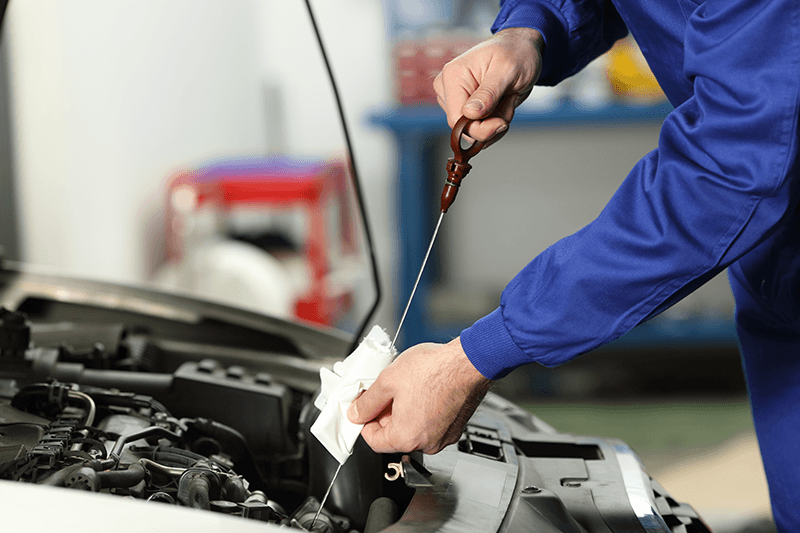
Check engine oil color and levels - dark or gritty oil indicates neglected maintenance
- Engine oil should be amber to light brown. If it's black and sludgy, the previous owner neglected basic maintenance — that's a red flag worth investigating further
- Coolant should be green, orange, or pink — never brown or rusty, which indicates corrosion in the cooling system
- Oil residue around gasket edges or the valve cover is worth noting. Minor seeping is common on older engines; active drips are not
- Ask for service records. Most honest sellers have at least some. The records aren't just proof of maintenance — they show you how the car was driven and whether problems were handled promptly or kicked down the road
Test Drive
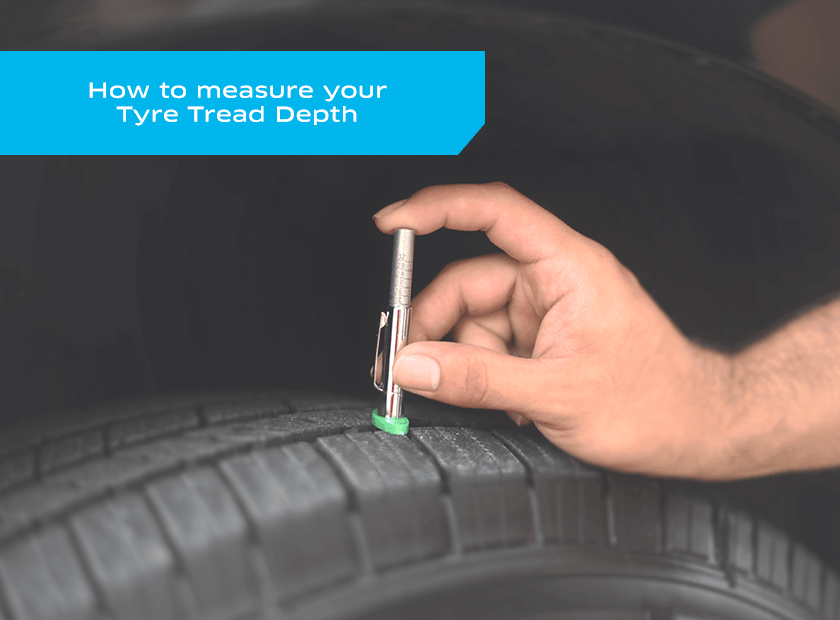
Check tire wear patterns during test drive - uneven wear suggests alignment issues
- Arrive before the seller warms the car up. Cold starts reveal problems that disappear once the engine reaches operating temperature — a seller who "just took it for a spin" before you arrived isn't doing you any favors
- Brake firmly from 40 mph. Pulling to one side means brake or tire issues. A pulsating pedal means warped rotors
- On the highway, ease your hands off the wheel briefly. Drift suggests an alignment or tire problem
- Clunks over bumps usually point to suspension wear. Grinding under acceleration is worth getting looked at before you buy
Budget $100-$150 for a pre-purchase inspection at an independent shop — specifically one with no connection to the seller. On a $12,000 car, that's about 1% of what you're spending, and it's the single step that most often catches problems before they become your problem. If a seller refuses to allow an inspection by a mechanic of your choosing, that refusal is the answer to whether you should buy the car.
Frequently Asked Questions
What's the best website to find used cars?
CarGurus labels listings as overpriced, fair, good, or great against actual market data — helpful for shortlisting without visiting every lot nearby. Cars.com and AutoTrader pull broader dealer inventory. For private listings, Facebook Marketplace has largely taken over from Craigslist in most markets. One consistent rule across all of them: never pay a deposit before seeing the car in person. The setup is almost always the same — seller claims to be shipping from out of state, needs a holding fee first. It works because the listing prices are just attractive enough to create urgency. Feel any pressure to pay before viewing, and the deal is done.
How much should I actually spend on a used car?
The standard guidance is keeping total vehicle costs — payment, insurance, fuel, maintenance — under 15–20% of monthly take-home pay. The more practical number: whatever the car costs, make sure you have at least $1,500–$2,000 left over for first-year repairs. Brakes, tires, a battery — these things show up in month two sometimes regardless of how clean the car looked at purchase. The buyers who end up stuck are usually the ones who spent everything getting into the car and had nothing left when something needed attention.
Is it risky to buy a used EV?
Prices have come down enough that the value proposition is real, especially if you charge at home. The main thing to nail down is battery health — get a state-of-health (SoH) report before you negotiate anything. Above 80% is solid; below 75% means meaningfully shorter range. It's also worth checking whether the original battery warranty transfers to new owners. Nissan's Leaf warranty covers capacity dropping below 75% for 8 years or 100,000 miles, and it does transfer, which changes the risk picture on higher-mileage units considerably.
Is Certified Pre-Owned worth the premium?
On a Toyota or Honda, no — those cars were already unlikely to need major work, and you're paying a premium for coverage that probably won't be used. On a BMW, Mercedes, or Audi, where a single out-of-warranty repair can run several thousand dollars, the warranty is paying for something real. Read the coverage terms before assuming anything; CPO programs vary a lot between manufacturers, and some exclude common wear items you'd expect to be covered.
How do I negotiate price at a used car dealership?
Start from Kelley Blue Book or CarGurus fair market value, not the asking price. Note specific visible issues — worn tires, a paint scuff, cracked trim — and use them as concrete reasons for a lower number rather than just asking for a general discount. Get pre-approved financing from your bank or credit union before you walk in; dealers can't redirect the conversation toward monthly payments if you're not using their financing. And walking away is a real option. Dealers follow up on people who leave more than most buyers expect, usually within a day or two.
What documents do I need when buying a used car?
You'll need the signed title from the seller, a bill of sale, and the vehicle history report. At a dealership, they handle the title transfer. In a private sale, you file with your local DMV yourself. Before money changes hands, confirm there are no open liens on the vehicle. A lien means a lender still has a legal claim on it, and that claim follows the car regardless of who buys it. Your state's DMV website can usually run a lien check, or a title company can do it for a small fee.
Final Thoughts
Most bad used car purchases come down to time pressure. A dealer suggesting the car won't last the weekend. A price that looked like it might disappear. Impatience with a process that genuinely takes a few days to do properly. The used car market is large enough that a comparable vehicle will come available — usually sooner than it feels in the moment. The few days it takes to run the history check, get the inspection done, and confirm your financing is a small ask on a $10,000-plus decision.
Know your full budget before you set foot on a lot — not the down payment, the full number including first-year costs. Have financing arranged in advance if you're not paying cash. And if something about a deal doesn't add up — vague answers about the car's history, a listing that keeps reappearing at different prices, a number that sits noticeably below every comparable vehicle — take that seriously. Those signals almost never resolve in the buyer's favor.

Finding the right used car is the start of a new journey — take your time to make the right choice
If you want to talk through specific models or see what we currently have in inventory, get in touch with the Unicom Motors team. We stock vehicles across a range of categories and price points, and we'd rather point you toward the right car than the wrong one.
0
Comments
Leave a Comment
Your email address will not be published. Required fields are marked *
Name can't be empty
Email error!
Message can't be empty
😍
😜
😳
😌
😄
😘
😝
😒
😃
😚
😚
😛
😟
😧
😀
😉
😓
😱
😤
😣
😂
😥
😩
😠
😢
😭
😰
😨
😡
😆
😪
😅
😐
😇
😋
😴
👿
😕
😏
😷
😵
😟
😮
😯
😑
👧
👴
😧
😬
😾
👶
👱
👵
👸
🙀
👺
👦
👩
👨
😽
😿
🙈
💩
💥
💤
😼
😹
🙉
🔥
✨
💦
👎
✌
👆
👈
💪
💹
👍
👊
💴
💶
💷
💸
👉
💵
🙏
🌎
🏧
👏
💳
👇
💑
🙆
🙅
💁
👫
👭
🙎
🙇
👑
👔
Submit Comment
Most Popular
-
 Jan 29, 2026Find a Jetour Dealer Near Me: Your Complete Buying Guide
 -
 Jun 22, 2026BYD Ocean Series: Dolphin, Seal & Seagull EVs Explained
 -
 Nov 19, 2025Chinese Car Export New Policy Explained: Impact, Requirements, and How We Help You Meet OEM Compliance
 -
 Nov 14, 2025Fang Cheng Bao Ti7 Overview: Full Specs, Features & Highlights


Laster Blogs
-
 Sep 20, 2026BYD Chairman Wang Chuanfu Visits Our DENZA and LEOPARD Dealerships
 -
 Sep 11, 2026How Much Does a Used Car Cost in 2026? Prices, Factors & Import Costs
 -
 Aug 31, 2026Chinese Used Car Buying Guide: How to Choose a Reliable Vehicle from China
 -
 Jul 15, 2026How to Safely Import Used Electric Cars for Sale in China: The Ultimate Battery (SOH) and Charging Standard Guide


Set A Consultation Today
Name can't be empty
Email error!
Send Your Message
*We respect your confidentiality and all
information are protected.


